
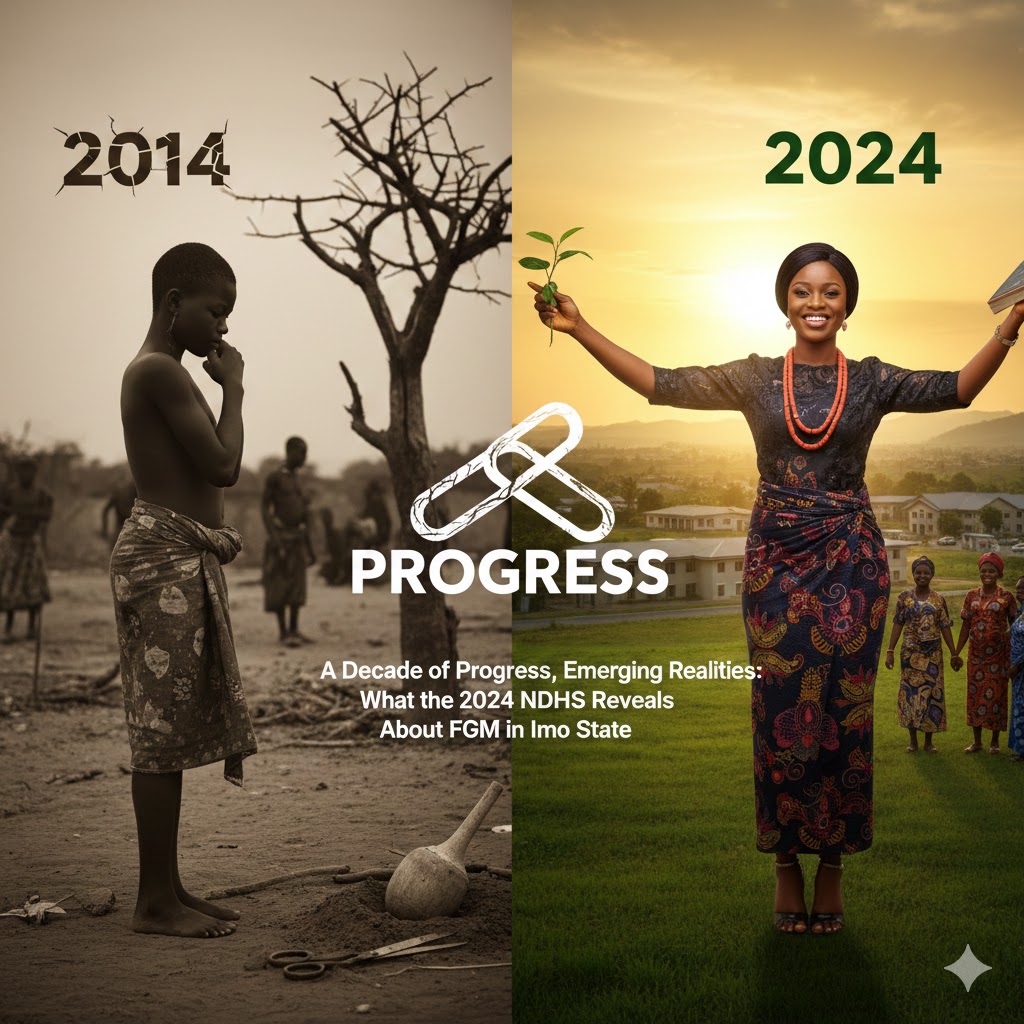

A Decade of Progress, Emerging Realities: What the 2024 NDHS Reveals About FGM in Imo State
Female Genital Mutilation (FGM) remains one of the most harmful traditional practices affecting women and girls in many parts of Nigeria. It involves the partial or total removal of external female genitalia for non-medical reasons. Globally and nationally, FGM is recognised as a violation of human rights, a health risk, and a form of violence that undermines the dignity, bodily autonomy, and well-being of women and girls. In Imo State, FGM is deeply rooted in cultural beliefs, with procedures often carried out on newborn baby girls—typically on the 8th day of life. Understanding the extent of the practice is essential for improving policies, strengthening interventions, and advancing the campaign to end FGM.
The 2024 Nigeria Demographic and Health Survey (NDHS) provides the most recent and reliable evidence on the practice of FGM in Imo State. A desk review of the data shows remarkable progress over the past decade, but also highlights new and emerging concerns that require urgent action from civil society organisations (CSOs), government Ministries, Departments and Agencies (MDAs), and development partners. The full NDHS 2024 report can be accessed here.
Understanding FGM: Types and Consequences
The World Health Organization (WHO) classifies FGM into four major types. Read more about them here on WHO:
- Type I (Clitoridectomy): Partial or total removal of the clitoris and/or clitoral hood.
- Type II (Excision): Partial or total removal of the clitoris and labia minora, sometimes extending to labia majora.
- Type III (Infibulation): Narrowing of the vaginal opening by cutting and repositioning the labia to form a seal.
- Type IV (Other harmful procedures): Pricking, piercing, scraping, cauterising, or any non-medical injury to the female genitalia.
Consequences of FGM
- Health risks: severe bleeding, infection, shock, complications during childbirth, chronic pain, scarring, increased maternal/newborn risks.
- Psychological/human rights impacts: trauma, fear, anxiety, reduced bodily autonomy, violation of fundamental rights.
- Social impacts: perpetuation of gender inequality, harmful norms, discrimination.
NDHS 2024 Desk Review: What the Data Shows for Imo State
Table 1: FGM Prevalence Among Women and Girls (2013–2024)
| Population Group | 2013 | 2018 | 2024 | Key Insight |
|---|---|---|---|---|
| Women 15–49 years | 68.0% | 61.7% | 34.3% | 50% decline over 11 years |
| Girls 0–14 years | 32.3% | 62.8% | 14.6% | Sharp drop in new cases |
Table 2: Age-Specific Prevalence for Girls (NDHS 2024)
| Age Group | 2024 Prevalence | Interpretation |
|---|---|---|
| 0–4 years | 6.2% | Newborn cutting reducing sharply; strong sign of abandonment |
| 5–9 years | 16.1% | Reflects past practices, not current newborn trends |
| 10–14 years | 23.1% | Older cohorts show historical exposure |
Table 3: Attitudes and Beliefs About FGM (NDHS 2024)
| Indicator | Women | Men | Key Insight |
|---|---|---|---|
| Believe FGM is required by religion | 30% | 13.7% | Myths influence decision-making |
| Support continuation of FGM | 6.7% | 16.1% | Men show higher support |
Table 4: Age of FGM Procedure in Imo State
| Variable | NDHS 2024 | Interpretation |
|---|---|---|
| Most common age of cutting | 8th day of life | FGM overwhelmingly occurs on newborns |
Why These Figures Are a Call for Concern for CSOs, MDAs, and Donor Partners
- Declining prevalence does not mean elimination: 34.3% of adult women still report FGM.
- Newborn girls remain at risk: cutting occurs predominantly on the 8th day after birth.
- Religious misconceptions persist: 30% of women believe FGM is required by religion.
- Male support is higher: 16.1% of men still support continuation, highlighting the need for male-focused engagement.
- CSOs and MDAs must sustain momentum: progress is fragile; monitoring, awareness, and intervention must continue.
- Donor partners must continue support: for scaling Community-Based Child Protection Committees (CBCPCs) and early intervention programs.
Moving Forward: A Renewed Call to Action
The NDHS 2024 provides both hope and a clear roadmap. Imo State has made measurable progress—and this should be celebrated. However, the data also makes one message clear: now is not the time to slow down.
Strengthening community structures, deepening religious engagement, empowering men and boys as allies, and expanding newborn protection mechanisms are critical to ensuring that no girl is subjected to FGM—now or in the future.
CYDI remains committed to working with government agencies, traditional and faith leaders, youth groups, women’s organisations, and international partners to sustain this progress and accelerate the campaign to end FGM in Imo State.